
IIn today’s modern world, everyone is speaking English but the one who speaks English at international level standards is the one who truly owns the room and drives success. But most learners will ignore the hidden melody of the language in their obsession to accumulate a huge vocabulary or perfect complex grammar. Being asked to repeat yourself over and over by your international colleagues? Maybe it’s not your accent, but your rhythm. Learning the all-important concept of word stress is the key to achieving that kind of native-like fluency that will help you to be perfectly understood in your professional communication across the globe.
What is the meaning of stress in English?
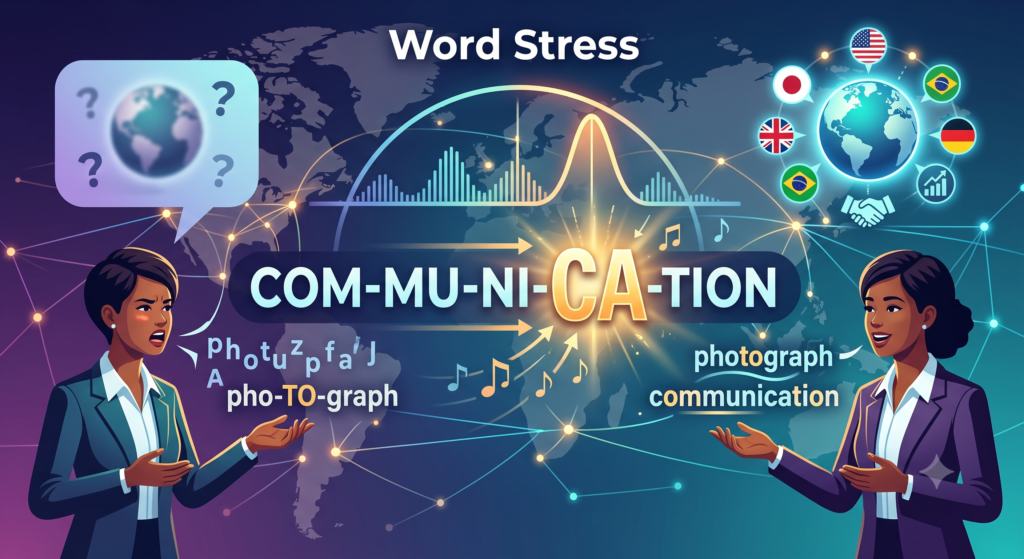
Indeed, English is one of the more musical languages out there. It gives equal time and weight to every syllable . It is very much a matter of the stress of syllables to convey meaning. Word stress is the process of emphasizing one particular syllable in a word, by saying it louder, longer and higher in pitch than the other syllables. Consider, for example, the word ‘photograph’. The fluent speaker will naturally stress the first syllable ( PHO-to-graph ). If you stress the middle ( pho-TO-graph ) the word becomes almost unintelligible to an international listener.
English is unusual in that it is musical . Many languages give equal time and stress to each syllable . The meaning depends a great deal on the accent of the syllables. Word stress is when we say one syllable in a word louder, for longer and higher than the other syllables . Take the word “photograph,” for instance. A fluent speaker naturally stresses the first syllable ( PHO-to-graph ) but stressing the middle syllable ( pho-TO-graph ) makes the word nearly impossible for an international listener to understand .
Global Business English and Its Influence
But a very important mistake is the lack of phonetic stress if someone wants to speak international English. A word may even change its grammatical function through wrong stress. Take, for example, the word “record.” In a business meeting, when you talk data, you talk of a RE-cord (noun, stress on first syllable). But if you are recording sound, you re-CORD (verb, stress on the second syllable). These English pronunciation rules will teach you to speak English fast and avoid expensive miscommunication in business.
Why do native speakers use stress patterns?
When you speak to professionals around the world, they don’t read every letter. They are learning the speed of your phonetic stress. They expect your stress patterns and suddenly your spoken English is a lot clearer.
Impact Beyond the Word: Sentence Stress in Communication
Once you have the word stress of single words down pat, you can use this rule for whole sentences to improve your spoken fluency. Emphasis should be given to content words (nouns, main verbs, adjectives), as they carry the main meaning of a sentence. In a particular sentence, structure words (pronouns, prepositions) are pronounced quickly and quietly. It is this dynamic contrast which creates the compelling, persuasive rhythm which is necessary for advanced international communications. It transforms a dull read into a vivid, compelling spoken message that catches the ear of an international audience.
To summarize, mastering the rhythm of word stress is a must-have milestone along your way to elite global fluency. That’s the difference between thick-accented, hard-to-understand speech, and clear, authoritative, engaging professional speech. By making sure you control the emphasis in your syllables you can always make sure your ideas have maximum impact. If you are ready to polish your spoken rhythm and get to that desired international standard, then we highly recommend the training at Communicative English Spark Edx. Through their intensive courses you will perfect your phonetic delivery to speak easily on the world stage.